Web Design
How to Give Great Design Feedback (Even If You're Not a Designer)
Feeling stuck giving design feedback? Learn how to share clear, actionable insights your agency will love, and get the results your business deserves.

.avif)
The Myth of the 'Design Eye'
Let’s start with a simple truth. You don't need to be a designer to give great design feedback. In fact, some of the most transformative feedback I’ve ever received came from someone who wouldn't know kerning from a kumquat. They once looked at a complex design we’d laboured over and said, "It feels like it's trying too hard."
That simple, honest feeling forced us back to the drawing board. It pushed us to find a more elegant, effortless solution that achieved the same goal. Now, we aim for that 'perfectly messy bed hair' look in our work. Effortless on the surface, but built on a foundation of thoughtful strategy. That's the power of good feedback.
Your role in the design process isn't to have a 'design eye'. Your role is to be the expert on your business, your brand, and your customers. Your feedback is the crucial bridge between a beautiful design and a design that actually works for your business. As research confirms, the quality of feedback from all stakeholders directly influences the final outcome. It’s a collaborative effort, and your voice is essential to ensuring we’re all aligned and moving in the right direction.
Common Feedback Traps to Avoid
Before we get into what makes feedback great, it helps to understand the common pitfalls. We’ve all been in review meetings where the feedback is more confusing than helpful. Avoiding these traps is the first step toward a more productive and positive process.
The 'I'll Know It When I See It' Problem
Feedback like "it needs more pop," "make it feel more modern," or the classic "I'm not sure, but something just feels off" is incredibly common. While the feeling is valid, the feedback itself is unactionable. It sends designers on a guessing game, trying to interpret a subjective feeling without any objective direction. This often happens when feedback guidelines aren't clear, leading to what the Nielsen Norman Group calls derailed critiques. The result is wasted time and a design that misses the mark.
Lost in Translation
There's often a vocabulary gap between designers and non-designers. You might say a page feels "cluttered" or "busy". A designer might see the same page and identify inconsistent spacing, a clashing colour palette, and poor typographic hierarchy. Your vocabulary isn't wrong; it's just a different way of describing the same problem. The key is to see this as the start of a conversation, not the end. A good design partner will hear "cluttered" and ask clarifying questions to diagnose the root cause, whether it's the wireframe structure or the visual details.
Playing Art Director
This is perhaps the most tempting trap. It's providing a solution instead of a problem. Feedback like "make the button red," "use this exact font," or "make the logo 20% bigger" can feel helpful, but it often shuts down creative problem-solving. By prescribing a solution, you might be overlooking a dozen better ways to solve the underlying issue. Your designer's job is to find the most effective solution to the problem you identify. Trust them to explore the possibilities.
A Framework for Feedback That Works
So, how do you move from subjective feelings to objective, actionable feedback? It comes down to shifting your perspective. Instead of reacting to what you see, analyse it through a strategic lens. Here’s a simple framework to guide you.
Start with the Objective
Every piece of feedback should be anchored to the project's goals. Before you say anything, pull up the original project brief that was agreed upon during the kickoff call. Ask yourself questions like:
- Does this design achieve our primary goal of increasing demo requests?
- Does this layout effectively communicate our unique value proposition?
- Does this align with the user experience we want to create for our target audience?
Focus on the Problem Not the Solution
This is the single most important shift you can make. Instead of telling the designer what to do, tell them what problem you're experiencing. This simple change empowers them to do their best work. Here are a few examples:
- Instead of: "Make the logo bigger."
- Try: "I'm concerned our brand identity isn't prominent enough in the hero section."
- Instead of: "The call to action button should be orange."
- Try: "The main call to action seems to be getting a bit lost on the page. How can we make it stand out more?"
Speak from Your User's Perspective
You know your customers better than anyone. Use that knowledge. Frame your feedback from their point of view. This moves the conversation away from "I like" or "I don't like" and toward what will be most effective for the people who will actually be using the site.
- "Our users are often busy and distracted. I'm worried this paragraph is too long for them to read on the go."
- "Based on what we know about our Ideal Client Profile (ICP), this imagery might not resonate with them."
- "From a new user's perspective, is it clear what the next step is after landing on this page?"
Practical Tips for Your Next Design Review
Frameworks are great, but how do you put this into practice? Here are a few tangible techniques to bring to your next review session to ensure the feedback is clear, organised, and effective.
Embrace the Process
The days of the dramatic "big reveal" are over. Modern, effective design is an iterative process built on early and frequent feedback. As UX professionals advocate, continuous collaboration keeps projects efficient and on budget. This is why our productised service model at Tahi Studio works so well. It encourages smaller, more frequent requests and reviews, which prevents misunderstandings and ensures the project stays aligned with your goals every step of the way.
Use a Single Source of Truth
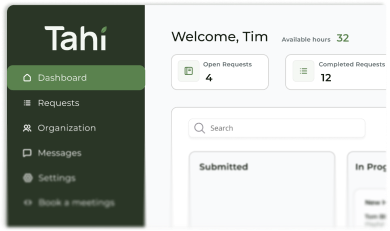
Feedback can get lost in sprawling email chains and multiple Slack channels. To keep everything organised and ensure nothing is missed, it's vital to have one central place for all comments and revisions. At Tahi, we manage this through a dedicated Client Dashboard for each partner. This becomes the single source of truth, housing all communication, files, and feedback in one organised space. It removes ambiguity and makes the entire process transparent and efficient.
The Language of Constructive Criticism
How you say something is just as important as what you say. The goal is to create a positive, collaborative environment where ideas can be shared freely without fear of personal criticism.
- It's a "We" Thing: Use inclusive language. Phrases like "What if we tried..." or "Could we explore an option that..." frame the feedback as a joint effort. It signals that you see yourself as a partner in the process, not just a client giving orders. As we often say, our job is to be your guide, and that journey is one we take together.
- Acknowledge the Positive: Before diving into what needs changing, take a moment to mention what's working well. "I really love the clean layout and the font choice. I have a question about the main image, though." This shows you're engaged and looking at the design thoughtfully, which makes the constructive feedback easier to hear and act upon.
- Be Honest About Your Feelings: It is perfectly okay to use emotional language, as long as it's framed as a problem to be solved. My "it's trying too hard" example is a perfect case. Saying "This feels a bit too corporate for our brand" or "I'm feeling a bit confused by this section" provides valuable data for a designer to work with.
You Are the Expert We Need
Giving great design feedback isn't a dark art. It’s a skill, and like any skill, it can be learned and improved. It’s not about knowing design terminology; it’s about knowing your business, understanding your goals, and communicating your perspective with clarity and honesty.
By focusing on problems instead of solutions, grounding your feedback in objective goals, and embracing a spirit of partnership, you can transform the design process. You become an invaluable collaborator who empowers your design team to create work that isn't just beautiful, but that delivers real, measurable results.
If you're ready for a partnership that values your expertise and turns your vision into a reality, we're here to help. Let's start with a conversation. We can begin with a free, no-obligation site audit to identify clear, actionable ways to improve your current website and see if we're the right fit to build something great together.